
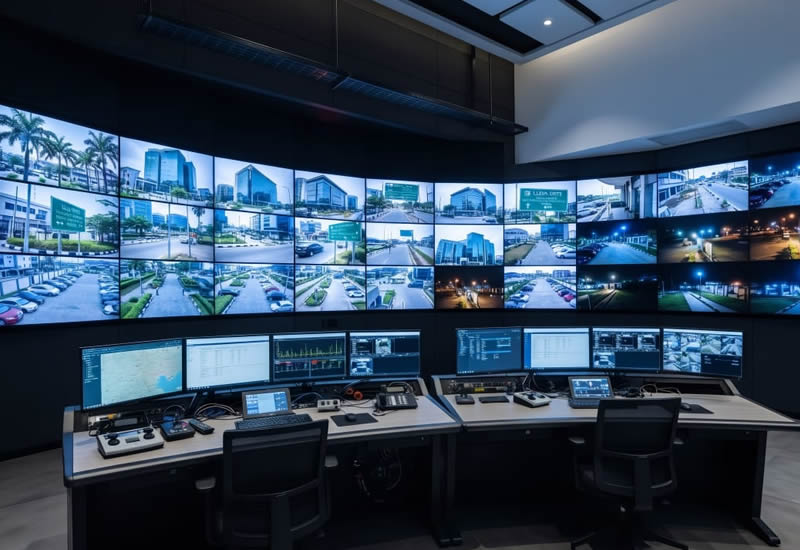
In modern security management, Closed-Circuit Television (CCTV) has become an important tool for protecting people, property, information and business operations. From corporate offices and shopping centres to manufacturing facilities, residential estates and critical infrastructure, surveillance systems help organisations monitor activities, identify potential threats and investigate security incidents. However, the presence of CCTV cameras does not automatically guarantee effective security. A facility may have dozens of cameras installed and still experience serious security breaches because the system was poorly designed, inadequately monitored or improperly managed.
For a modern security manager, understanding CCTV goes beyond knowing how cameras work or how to retrieve recorded footage. It requires an appreciation of surveillance technology, risk assessment, camera positioning, video quality, recording systems, operational procedures, cybersecurity and the legal responsibilities associated with monitoring people. The real value of CCTV is not measured by the number of cameras installed, but by how effectively the system supports security decisions, incident prevention, detection, response and investigation.
Understanding How CCTV Systems Work
A CCTV system consists of interconnected devices that capture, transmit, display, record and store video footage. At its most basic level, cameras capture images of activities within designated areas and transmit those images to a recording or monitoring system. Depending on the technology, footage may be viewed in real time, stored for later examination or accessed remotely by authorised personnel.
Traditional analogue CCTV systems transmit video signals through cables to a Digital Video Recorder (DVR), where the footage is converted into digital recordings and stored. Modern Internet Protocol (IP) cameras, on the other hand, transmit digital video over computer networks and are commonly managed through Network Video Recorders (NVRs) or Video Management Systems (VMS). These systems may provide additional capabilities such as remote monitoring, automated alerts, advanced video analytics and integration with other security technologies.
A security manager does not necessarily need to become a CCTV installation engineer. However, understanding these basic components is essential for communicating effectively with technical contractors, evaluating equipment proposals, identifying system limitations and ensuring that the organisation’s investment meets its security requirements.
CCTV Should Begin with Security Risk Assessment
One of the most common mistakes organisations make is purchasing CCTV equipment before clearly defining what the surveillance system is expected to achieve. Cameras are sometimes installed simply because certain locations appear important or because similar facilities already have them. This approach can produce extensive camera coverage without adequately addressing the organisation’s most significant security risks.
An effective CCTV project should begin with a security risk assessment. The security manager must identify vulnerable locations, evaluate potential threats, understand operational activities and determine which areas require continuous observation or recorded evidence. These may include entrances and exits, perimeter boundaries, loading bays, car parks, warehouses, cash-handling areas, reception points, server rooms and other sensitive locations.
The purpose of each camera should also be clearly defined. Some cameras may be required to detect movement within a restricted area, while others may need to provide sufficient detail to identify individuals or establish the sequence of events during an incident. These objectives influence camera selection, positioning, image quality and recording requirements.
For example, a camera positioned high above a warehouse may provide an excellent overview of activities but fail to capture sufficient facial detail to identify someone involved in theft. Similarly, a camera positioned at a building entrance may produce clear images during the day but become ineffective at night because of poor lighting.
The important lesson is that camera coverage and useful surveillance are not the same thing. A properly designed system must provide the right information, at the right location and at the right time.
Understanding Different Types of CCTV Cameras
Modern CCTV systems offer several camera types designed for different operational environments. Fixed cameras monitor a particular area continuously and are commonly used at entrances, corridors and other designated security points. Dome cameras are often selected for indoor environments because of their compact appearance and protective housing, while bullet cameras are frequently used for outdoor surveillance where a visible camera may also contribute to deterrence.
Pan-Tilt-Zoom (PTZ) cameras allow authorised operators to change viewing direction and zoom in on activities of interest. They are particularly useful for monitoring large facilities, car parks and open spaces. However, a PTZ camera cannot simultaneously observe every direction. When an operator focuses on one location, activities elsewhere may go unnoticed. Consequently, PTZ cameras are often most effective when supporting fixed cameras that provide continuous coverage.
Thermal imaging cameras detect differences in heat radiation and can support surveillance in certain low-visibility conditions. Infrared-enabled cameras can provide night-time images where appropriate infrared illumination is available, while panoramic cameras offer wider views of large spaces.
The security manager must understand that different technologies serve different purposes. A high-resolution camera is not automatically the best choice for every location, just as an expensive camera cannot compensate for poor positioning, unsuitable lighting or inadequate maintenance.
Image Quality, Camera Positioning and Lighting
Image quality is one of the most important considerations in CCTV management. Security managers frequently encounter terms such as resolution, megapixels, frame rate, field of view, focal length and video compression. Although these terms may appear technical, they directly affect whether recorded footage will be useful during an investigation.
Resolution refers to the amount of image detail a camera can capture. Higher-resolution cameras can provide clearer images, but actual performance also depends on lens quality, lighting, compression, movement and the distance between the camera and the subject. Frame rate determines how many images are recorded per second and can affect the smoothness of video, particularly when monitoring fast-moving activities.
Camera positioning is equally important. A camera mounted too high may provide a wide view but capture limited facial detail. One positioned directly towards bright sunlight may produce images affected by glare or excessive contrast. Poorly positioned cameras can also leave blind spots that offenders may exploit.
Lighting conditions deserve particular attention because the effectiveness of a camera can change significantly between daytime and night-time. A location that appears well covered during routine daytime inspections may become difficult to monitor after business hours.
The UK’s National Protective Security Authority emphasises the importance of properly designed CCTV coverage, suitable lighting, trained operators and integration with other protective measures.
For security managers, this means that system evaluation should include practical tests under realistic operating conditions rather than relying entirely on manufacturers’ specifications.
CCTV Monitoring Requires Human Judgement
One important distinction in security management is the difference between recording activities and actively monitoring them. A CCTV system may record events continuously without anyone observing the footage in real time. While such recordings can support investigations, they may offer limited immediate protection if suspicious activities are not detected until after an incident has occurred.
Live monitoring requires trained personnel who understand the facility, recognise unusual behaviour, assess potential threats and follow established incident response procedures. The effectiveness of the system therefore depends on both technology and the competence of its operators.
Consider a situation in which a person repeatedly walks around a restricted warehouse entrance without entering. A camera may capture the behaviour, but the security value comes from an operator recognising the activity as potentially suspicious, assessing the circumstances and taking appropriate action. This may involve alerting a supervisor, communicating with a patrol team or directing further observation towards the location.
Security managers should establish clear monitoring procedures, incident escalation protocols, communication channels and operational responsibilities. Operators must also understand the limits of their authority and the importance of reporting observations objectively rather than making unsupported assumptions about individuals.
A sophisticated CCTV system operated without adequate training, supervision or clear procedures may deliver less security value than a simpler system managed by competent professionals.
Recording, Storage and Retrieval of CCTV Footage
Recording and storage are critical aspects of CCTV operations because footage may become essential evidence during investigations, disciplinary proceedings, insurance claims or legal disputes.
Security managers should understand how their systems store footage, how long recordings remain available and what happens when storage capacity is exhausted. Some systems automatically overwrite older recordings when available storage becomes full. If this process is not properly understood, footage relating to an incident may be permanently lost before it can be retrieved.
Storage requirements depend on several factors, including the number of cameras, recording resolution, frame rate, compression settings, recording schedules and retention periods. A facility operating numerous high-resolution cameras continuously will generally require more storage than one using fewer cameras or event-based recording.
Organisations should establish documented retention policies based on operational needs, legal obligations and the purpose of surveillance. There is no universally appropriate retention period for every CCTV installation. The UK’s Information Commissioner’s Office, for example, advises organisations to determine retention according to the purpose of the recording rather than simply retaining footage for as long as storage capacity permits.
The security manager should also ensure that important footage can be located and exported without unnecessary delay. Recordings associated with incidents must be preserved appropriately, with accurate dates, times and records of who accessed or handled the footage. Where footage may be used as evidence, a documented chain of custody helps establish its integrity and reliability.
CCTV and Cybersecurity: Protecting the Surveillance System Itself
Modern CCTV systems are increasingly connected to organisational networks and remote monitoring platforms. While this connectivity provides operational benefits, it also introduces cybersecurity risks that security managers cannot afford to ignore.
Network-connected cameras, recording devices and video management platforms may become vulnerable when default passwords remain unchanged, software updates are neglected, remote access is poorly secured or devices are connected to inadequately protected networks. An attacker who compromises a CCTV system may gain unauthorised access to footage, interfere with recording or use the device as a potential entry point into other connected systems.
This creates an important responsibility for security managers. Surveillance equipment must not only protect the facility; the surveillance infrastructure itself must also be protected.
Effective controls include strong authentication, restricted user permissions, secure remote connections, appropriate network separation, timely security updates and cooperation with the organisation’s information technology team. Access to live and recorded footage should be limited to individuals whose responsibilities require it.
When procuring new systems, managers should also consider interoperability and cybersecurity support. For example, ONVIF, an industry standardisation organisation for IP-based physical security products, announced in October 2025 that it would phase out support for its older Profile S and recommend Profile T as its successor, partly because of changing cybersecurity requirements.
This reinforces an important principle: CCTV procurement decisions should consider long-term security, compatibility and maintainability, not merely initial purchase costs.
Integrating CCTV with Other Security Systems
A modern security operation should not treat CCTV as an isolated technology. Its effectiveness can be improved when it operates alongside access control, intrusion detection, fire and safety systems, alarm monitoring and other security procedures.
For example, when an access control system detects an unauthorised attempt to enter a restricted room, an integrated CCTV system may automatically display the associated camera feed to the control room operator. Similarly, an intrusion alarm can direct attention towards the affected location, allowing security personnel to assess the situation before deploying a response team.
Video analytics can provide additional support by detecting certain defined events, such as movement across a virtual boundary, the presence of an object in a restricted area or unusual activity patterns. However, analytics systems can generate false alarms or fail to detect events under challenging conditions. Their performance should therefore be evaluated carefully and supported by human verification.
Integration should ultimately improve the speed, accuracy and coordination of security responses. The purpose is not simply to connect more devices, but to ensure that relevant information leads to timely and appropriate action.
Privacy, Professional Ethics and Responsible Surveillance
CCTV systems capture information about people’s movements, behaviour and activities. Their use therefore creates responsibilities relating to privacy, confidentiality, fairness and lawful processing of personal information.
Security managers must ensure that surveillance serves legitimate and clearly defined purposes. Cameras should not be positioned in locations where individuals have a strong expectation of privacy, such as toilets or changing rooms. Surveillance arrangements should also comply with applicable data protection laws, employment requirements and organisational policies.
In Nigeria, organisations handling personal data must consider their responsibilities under the Nigeria Data Protection Act 2023 and other applicable legal requirements. Relevant considerations include lawful processing, transparency, appropriate safeguards, retention and the rights of individuals whose personal information is captured.
Access to CCTV footage must be controlled. Recordings should not be casually shared with colleagues, circulated through messaging platforms or published on social media simply because an incident has attracted attention. Any disclosure should have a legitimate and lawful basis and follow approved procedures.
The professional responsibility of the security manager is to balance organisational protection with respect for individuals’ rights. Surveillance should strengthen trust and accountability rather than create opportunities for intimidation, misuse or unnecessary intrusion.
Maintenance and Continuous Performance Evaluation
A CCTV system that worked effectively during installation may gradually become unreliable if it is not maintained. Camera lenses may become dirty, environmental conditions may change, cables and connections may deteriorate, storage devices may fail and software may become outdated.
Changes to the physical environment can also affect surveillance effectiveness. New buildings, advertising structures, vegetation, equipment or partitions may obstruct previously clear camera views. A system installed several years earlier may no longer provide adequate coverage for a facility whose operations have expanded.
Security managers should therefore establish routine inspection, maintenance and performance review procedures. These should examine camera availability, image quality, recording functionality, storage capacity, date and time accuracy, network connectivity and the ability to retrieve footage.
A particularly useful management practice is to periodically select a camera and attempt to retrieve a recording from a previous date. This simple exercise can expose faults that might otherwise remain undetected until footage is urgently required.
Maintenance should be proactive rather than reactive. Discovering that a camera has not recorded for several weeks during an investigation is not simply a technical failure. It represents a weakness in security supervision and operational assurance.
The Strategic Role of the Security Manager
The security manager’s responsibility is not to supervise cameras in isolation but to ensure that the CCTV system contributes meaningfully to the organisation’s broader security objectives.
This requires an understanding of operational risks, technology, people, policies and performance. Security managers must be able to explain why particular cameras are necessary, what threats they are intended to address, how surveillance information supports security decisions and whether the system provides value for the organisation.
For example, if a company repeatedly experiences losses within a warehouse despite having extensive CCTV coverage, the correct management response may not be to install additional cameras immediately. The manager should first determine whether existing cameras cover the relevant areas, whether the recorded images are usable, whether access control procedures are effective, whether incidents are reviewed promptly and whether staff are following established security protocols.
The underlying problem might be inadequate supervision, poor inventory controls, ineffective investigations or weak coordination between departments. CCTV can help reveal these weaknesses, but it cannot resolve them without appropriate management action.
Security managers should also be able to present surveillance performance to senior management in business terms. Reports may address system availability, recurring incident locations, response effectiveness, maintenance concerns, investigation outcomes and improvements required to reduce organisational exposure to risk.
This is where technical knowledge becomes strategic leadership. A manager who understands both the technology and the business environment can make better recommendations, justify investments and strengthen the organisation’s overall security performance.
Conclusion: CCTV Is a Security Management Responsibility, Not Just a Technical Installation
Understanding CCTV systems is an essential professional competence for modern security managers. Although specialist technicians may handle installation, configuration and repairs, the security manager remains responsible for ensuring that the surveillance system meets operational needs and supports effective risk management.
The most important question is not whether an organisation has CCTV cameras, but whether those cameras provide useful information that enables security personnel to detect threats, respond appropriately, protect evidence and improve security outcomes.
A camera can record an incident, but it takes a properly managed security system to turn that recording into meaningful protection, reliable evidence and better decisions.
As surveillance technology continues to develop, security managers must continually improve their knowledge of CCTV operations, digital security, data protection and integrated security management. Those who understand how technology, people and procedures work together will be better equipped to manage contemporary security risks and contribute meaningfully to organisational resilience.
For security professionals transitioning from government service into corporate security, acquiring practical CCTV knowledge is particularly valuable. It provides a foundation for understanding modern security operations and the technological expectations of today’s private-sector employers. Continuous professional development in CCTV and video surveillance management can therefore strengthen both operational competence and long-term career opportunities.